Binolla Demo Account Trading
Open a free demo account to explore the Binolla platform in detail and ultimately decide whether to trade here or not. Also, check out our beginner’s guide.
Setting Up Your Demo Account
Creating a practice account takes just minutes and provides immediate access to trading functionality. The registration process offers two efficient methods to accommodate different user preferences.
STEP 1: Registration
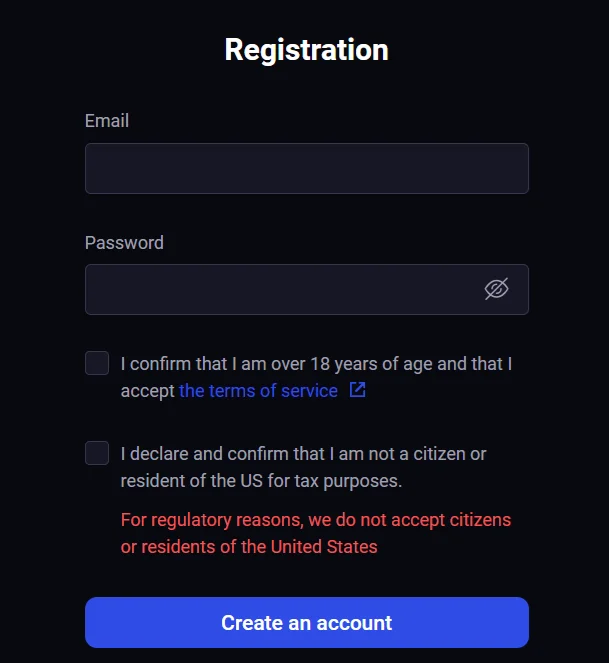
The standard registration method requires minimal information:
- Visit the official website (Click on the button below)
- Click the “Sign up” button located in the upper right corner
- Enter a functioning email address and create a secure password
- Review the privacy policy and check the confirmation box
- Click “Create an account” to complete registration
This information is sufficient for now; demo trading does not require uploading any documents or setting up payment details.
STEP 2: Enabling Demo Mode in the Trading Terminal
After registering and logging into the platform for the first time, you will immediately see the trading terminal with a familiar interface that you’ve likely seen on other trading platforms. Your balance will be zero — this is a real account, and since it’s empty, obviously you cannot make trades yet.
So, as shown in the screenshot below, click on the “zero” and you’ll see a switch between the demo and live accounts.
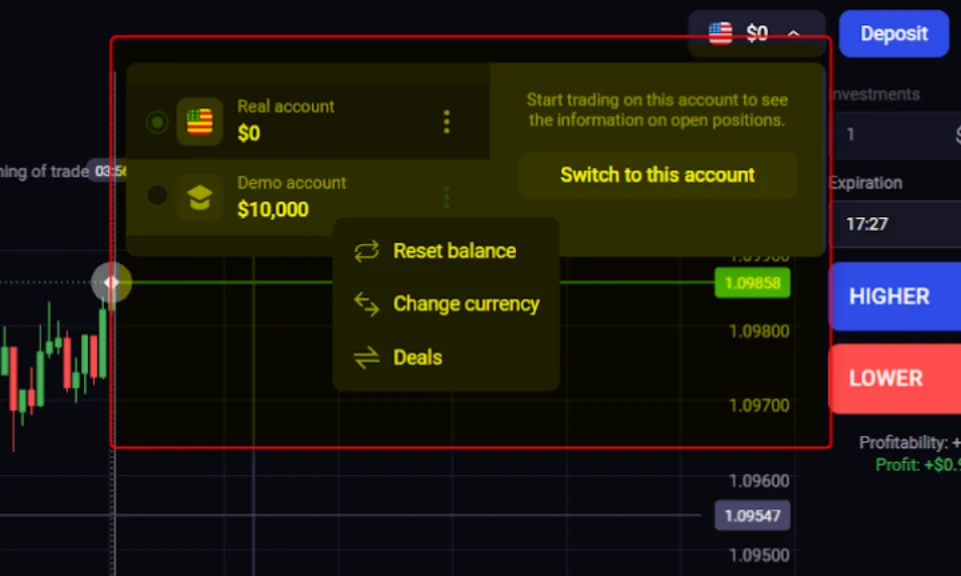
The demo account has a virtual balance, which is enough to make many trades, considering the minimum trade size is only $1.
Are trading conditions the same for demo and real accounts?
Yes. The Binolla Demo Platform uses real-time market data with the same spreads, execution speeds, and price movements as the real trading environment. This allows you to develop and test strategies under conditions very close to live trading.
However, no one can guarantee that a trade profitable in the demo account will necessarily be profitable in the real account, since market conditions change every second.
Can I reset my demo account if I lose the virtual funds?
Yes. If your practice account balance falls below the initial $10,000, you can reset it for free through the account settings menu. This reset option is available unlimited times at no cost, allowing continuous practice without restrictions.
Additionally, you can freely switch between the demo and real accounts at any time — there are no restrictions or pressure to trade on the real account.
How Demo Trading Builds Essential Market Skills
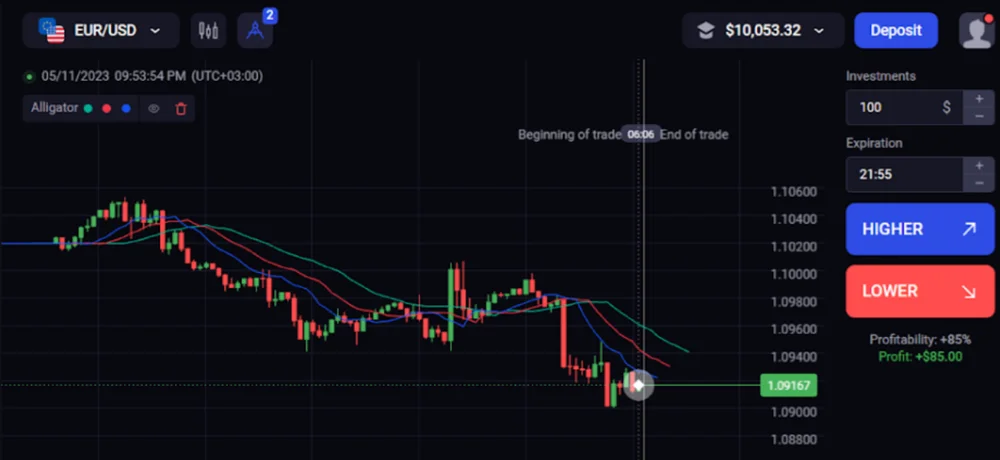
Trading success depends on developing multiple skill sets simultaneously. A practice environment allows traders to focus on each component without the pressure of potential financial loss. Most market participants who skip this crucial preparation phase find themselves making costly mistakes that could have been avoided.
Demo trading provides an ideal opportunity to practice technical analysis, test trading plans, and develop emotional discipline. The psychological aspects of trading often prove more challenging than the analytical components. Virtual trading helps build resilience against common emotional triggers like fear, greed, and impatience that frequently derail trading accounts.
| Skill Category | Demo Trading Focus | Transfer to Live Trading |
| Technical | Platform navigation, order execution | Direct application |
| Analytical | Chart reading, pattern recognition | Identical process |
| Strategic | Testing trading plans, evaluating results | Needs psychological adjustment |
| Psychological | Building routine, following rules | Additional discipline required |
| Risk Management | Position sizing, stop placement | Same principles, higher stakes |
The skills developed through demo trading directly transfer to real market situations. Chart patterns, indicator signals, and price action behave identically in both environments because they use the same underlying market data. The only meaningful difference lies in the psychological response to profits and losses, which changes when real money enters the equation.
New traders should focus on mastering platform functionality first. Understanding how to place different order types (market, limit, stop), modify existing positions, and implement proper position sizing creates the technical foundation for successful trading. Only after these mechanical skills become second nature should focus shift to strategy development and execution.
Available Assets and Markets in the Demo Environment
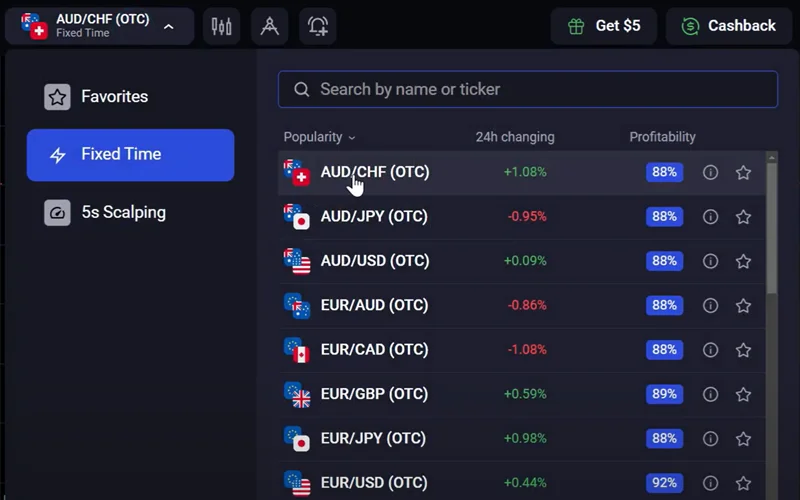
The Demo Account features extensive instrument selection across multiple asset classes. This diversity allows traders to identify markets that match their analytical strengths, risk tolerance, and availability for active trading.
Currency Pairs (Forex)
The platform provides access to major and minor currency pairs with competitive spreads:
- Major pairs: EUR/USD, GBP/USD, USD/JPY, AUD/USD
- Minor pairs: EUR/GBP, USD/CHF, USD/CAD
- Exotic pairs: USD/TRY, EUR/NOK, USD/ZAR
Forex markets operate 24 hours during weekdays, making them accessible for traders in any time zone. The high liquidity and technical nature of these markets make them popular choices for both new and experienced traders.
Commodities and Indices
For traders interested in broader market exposure:
- Energy: Crude oil, natural gas
- Metals: Gold, silver, platinum
- Agricultural: Coffee, wheat, sugar
- Major indices: S&P 500, NASDAQ, Dow Jones, DAX
These markets often respond strongly to fundamental factors, creating opportunities for traders who incorporate economic data and news events into their analysis.
Stock CFDs and Cryptocurrencies
The platform also includes:
- US technology stocks: Apple, Amazon, Microsoft
- Global corporations: Toyota, Samsung, Volkswagen
- Cryptocurrencies: Bitcoin, Ethereum, Litecoin, Ripple
This diverse selection enables traders to practice on instruments with different volatility profiles and market behaviors. Testing strategies across multiple asset classes helps identify which markets best match individual trading styles.
| Asset Class | Typical Volatility | Trading Hours | Margin Requirements |
| Forex | Low to Medium | 24/5 | 3.33% – 5% |
| Commodities | Medium to High | Market-specific | 5% – 10% |
| Stock CFDs | Varies by stock | Exchange hours | 20% |
| Cryptocurrencies | Very High | 24/7 | 50% |
Platform Features and Trading Tools
The trading platform provides professional-grade tools that match those available in the live trading environment. This equivalence ensures skills developed during practice transfer seamlessly to real trading.
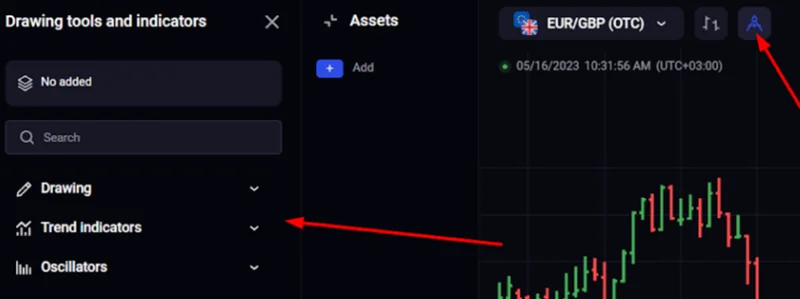
Charting Capabilities
The platform includes advanced charting with multiple customization options:
- Multiple timeframes from 1-minute to monthly charts
- Over 100 technical indicators for detailed analysis
- Drawing tools for trend lines, channels, and Fibonacci measurements
- Customizable chart layouts and color schemes
- One-click trading directly from charts
These tools support various analytical approaches from simple price action to complex multi-indicator systems. The platform’s responsiveness ensures smooth chart manipulation even during volatile market conditions.
Order Types and Execution
Traders can utilize several order types to implement precise entry and exit strategies:
- Market orders for immediate execution
- Limit orders for specified entry prices
- Stop orders for risk management
- Take profit orders for automated profit collection
- Trailing stops that move with favorable price action
Learning to use these order types effectively represents a critical skill that directly transfers to profitable trading. The demo environment allows experimentation with different order combinations without financial consequences.
Effective Practice Strategies Using Demo Accounts
Maximizing the educational value of demo trading requires a structured approach. Random trading without clear objectives limits skill development and can establish poor habits. The following strategies help extract maximum benefit from practice trading.
Simulating Real Trading Conditions
Effective demo practice closely resembles real trading conditions:
- Trade only with position sizes you would use with real capital
- Implement strict risk management (limit risk to 1-2% per trade)
- Maintain a detailed trading journal documenting decisions
- Follow a defined trading plan with clear entry and exit criteria
- Respect market hours relevant to your chosen assets
This disciplined approach ensures skills and habits developed transfer effectively to live trading. Many successful traders recommend setting artificial consequences for breaking rules during demo trading to reinforce good practices.
Progressive Skill Development
Rather than attempting to master all trading aspects simultaneously, focus on developing specific skills sequentially:
- Platform navigation and basic order execution
- Reading price charts and identifying key levels
- Implementing fundamental technical analysis concepts
- Testing specific entry and exit strategies
- Developing consistent risk management habits
This progressive approach builds competence systematically while preventing the overwhelm common among new traders. Each skill area should receive focused attention until demonstrating consistent proficiency.
Can I withdraw funds from my demo account?
No. The demo account uses virtual funds for practice purposes only. These virtual balances have no monetary value and cannot be withdrawn or converted to real money. To trade with withdrawable funds, you must open a real trading account with an actual deposit.
Transitioning From Demo to Live Trading
Moving from practice to real trading represents a critical transition that many traders mismanage. The challenge involves transferring skills while adjusting to the psychological impact of risking actual capital.
Performance Benchmarks for Readiness
Before moving to live trading, evaluate your preparedness using objective criteria:
| Performance Metric | Minimum Target | Ideal Target |
| Win Rate | >45% | >55% |
| Risk-Reward Ratio | >1:1.5 | >1:2 |
| Maximum Drawdown | <15% | <10% |
| Trading Plan Adherence | >90% | >95% |
Meeting these benchmarks indicates sufficient skill development to consider live trading with minimal initial capital.
Graduated Exposure Method
The most effective transition approach involves gradually introducing real capital:
- Open a real account with the minimum deposit ($10-100)
- Trade with significantly smaller position sizes than demo trading
- Use identical strategies proven successful in practice
- Maintain both demo and real accounts simultaneously
- Gradually increase position sizes as confidence builds
This conservative approach minimizes financial risk while adjusting to the psychological differences between demo and live trading. Many successful traders maintain this parallel approach indefinitely, using demo accounts to test new strategies before implementing them with real capital.
Psychological Adjustments
The transition to live trading introduces emotional elements absent in demo environments:
- Trading smaller position sizes initially reduces emotional pressure
- Implementing pre-planned responses to emotional triggers prevents reactive decisions
- Maintaining detailed trading journals with psychological observations identifies patterns
- Setting realistic performance expectations prevents disappointment
Acknowledging these psychological factors helps prevent emotional decision-making that undermines trading performance. Even experienced traders periodically return to demo trading to refine skills or test new approaches without psychological pressure.
Demo trading represents an essential step in developing trading proficiency. By providing a realistic yet risk-free environment, it bridges the gap between trading theory and practical application. Take advantage of this tool to build solid trading skills before committing real capital to the markets.
Risk Disclosure: Trading financial instruments involves significant risks and may not be suitable for every investor. There is a chance of losing the entire invested capital. Please make sure that trading is allowed under the laws of your country before proceeding.